
Something genuinely interesting happened to this category. Vendors stopped selling seats and started selling resolutions. You now pay when the AI actually solves something, which sounds fairer and creates a budgeting problem nobody warns you about.
Here is how the main options compare, and what to check before you sign anything.
The Pricing Shift Comes First
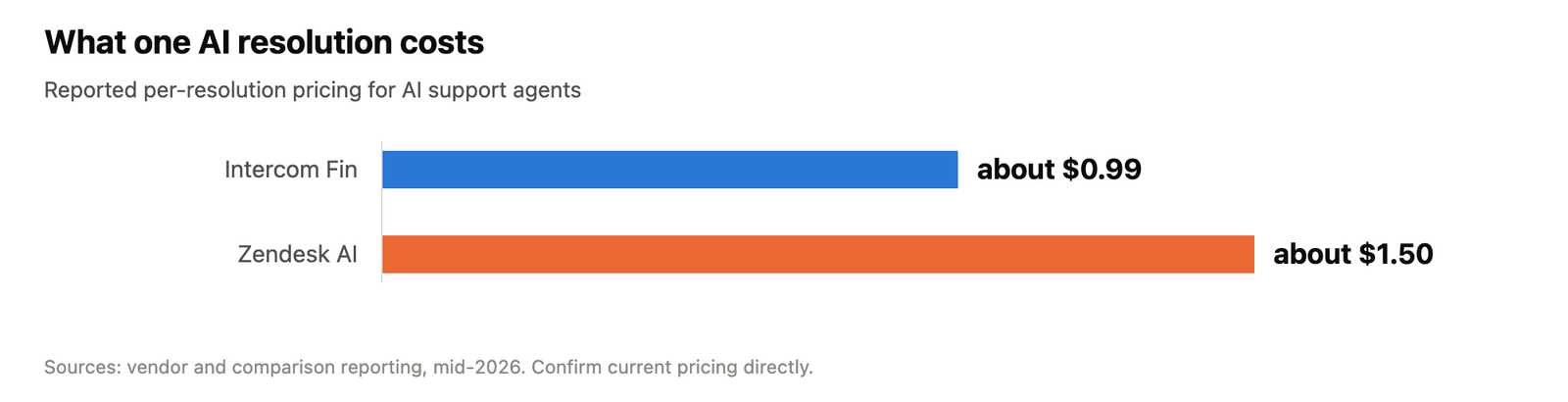
Intercom set the pattern with Fin at a widely reported $0.99 per resolution, defined as one outcome per conversation regardless of how many messages it takes. Zendesk AI agents are reported around $1.50 per resolution, with some plans listing $0.99 and lower per-answer rates depending on tier.
The catch is forecasting. Per-seat pricing is predictable and wrong. Per-resolution pricing is accurate and volatile. If your ticket volume is seasonal, model your worst month before you commit, and ask precisely how a resolution is defined. That definition is the entire contract.
The Platforms Worth Shortlisting
Intercom Fin
The most polished implementation in the category, and the reference point everyone else is measured against. Strong out of the box, quick to deploy on an existing help centre.
Best for: teams already on Intercom, or anyone wanting the shortest path to a working AI agent. Watch: cost at high volume adds up quickly.
Zendesk AI
The natural choice if you already run Zendesk, because the integration work is largely done and your data is already there.
Best for: existing Zendesk estates. Watch: per-resolution rates reported higher than several competitors.
Sierra
Built for teams that want an agent doing more than answering questions, taking real actions in connected systems. Enterprise-focused with custom pricing.
Best for: complex support where resolution means acting, not explaining. Watch: a sales process, not a signup.
Decagon
Another enterprise-focused challenger competing on resolution quality and configurability rather than breadth of helpdesk features.
Best for: high-volume support teams with the appetite to tune. Watch: custom pricing, so benchmark it against per-resolution rivals.
Ada and Maven AGI
Both established alternatives with strong automation depth, frequently shortlisted against Fin by teams that want to avoid platform lock-in.
Best for: organisations wanting an AI layer that is not tied to one helpdesk vendor.
What to Test in a Pilot
| Test | Why |
|---|---|
| Your ten worst tickets | Demos use easy questions. You do not have easy questions. |
| Escalation handover | Does the human get context or start cold |
| Reopen rate after AI resolution | The number that reveals fake resolutions |
| Behaviour when it lacks an answer | Confident guessing is the failure mode that costs customers |
| Cost at your peak month | Not your average month |
The Number Nobody Volunteers
Ask every vendor for reopen rate on AI-resolved tickets from a comparable customer. A resolution that comes back within 48 hours was not a resolution, it was a delay you paid for.
Ask also what happens to your knowledge base. The best implementations improve it continuously from resolved tickets. The weakest ones depend on a knowledge base you must maintain by hand, which is the actual work nobody scoped.
Conclusion
Shortlist on integration fit first, because migrating helpdesks costs more than any per-resolution difference. Model your peak month rather than your average, pin down the definition of a resolution in writing, and pilot on your hardest tickets. Then track reopen rate weekly for the first quarter. That single metric tells you whether you bought automation or a queue with better manners.
Frequently Asked Questions
Is per-resolution pricing better than per-seat?
It aligns incentives well and forecasts badly. Negotiate a volume band with a ceiling so a busy quarter does not produce an unpleasant invoice.
What resolution rate should we expect?
For tier-one questions, somewhere in the 50% to 65% range is a defensible target. Higher claims usually count deflection rather than genuine resolution.
Can we keep our current helpdesk?
Often yes. Several platforms are designed to sit on top of an existing helpdesk, which is usually cheaper and far less disruptive than replacing it.