
Accounts payable is the least glamorous automation project in the building and reliably one of the most profitable. Nobody puts it in a keynote. It just quietly stops costing money.
The numbers are unusually well documented here, which makes this one of the few AI business cases you can build without hand-waving.
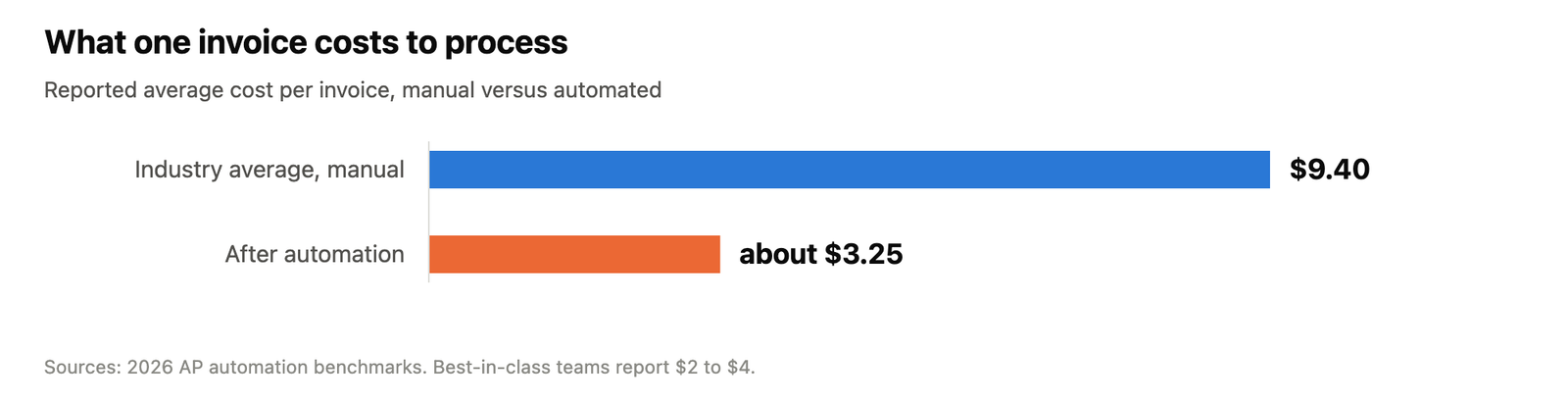
The Benchmark Numbers
Industry research puts the average cost to process a single invoice at roughly $9.40, with manual processing commonly cited between $8 and $15 and reaching $30 in the worst estates. Best-in-class AP teams process invoices for $2 to $4 each, and automated processing costs are estimated to land around $3.25.
Cycle time tells the same story. Manual workflows commonly run eight days end to end, and in poorly run estates 25 days or more from receipt to payment.
The Metric That Drives Everything Else
Touchless rate is the number to build your case on. It measures the share of invoices that go from arrival to payment with no human intervention at all.
Industry average sits around 32.6%. Best-in-class reaches roughly 49.2%. Notice that even the leaders touch half their invoices. Anyone promising you 95% touchless is selling a demo, not a system.
Where the Savings Actually Come From
| Source | Share of the benefit | Notes |
|---|---|---|
| Data entry removed | Large | The obvious one, and the easiest to model |
| Exception handling reduced | Larger | Exceptions cost several times a clean invoice |
| Early payment discounts captured | Underrated | Often funds the whole project alone |
| Duplicate and error prevention | Variable | Highly dependent on current controls |
| Audit preparation time | Small but real | Nobody counts it until audit week |
Most business cases model only the first row and then underdeliver on the promise. The exception queue is where the money actually sits, because a disputed invoice can cost many times a clean one to resolve.
Building a Case Finance Will Believe
- Count your actual invoices. Annual volume, split by supplier concentration. The top twenty suppliers usually account for most of the volume and least of the trouble.
- Measure your real cost per invoice. Fully loaded staff time, not a vendor benchmark. Finance will check.
- Measure your current touchless rate. Most teams have never calculated it. If it is already 40%, your upside is smaller than the brochure suggests.
- Price the exception queue separately. Time per exception times exception count is often the largest single number in the model.
- Add discount capture. If cycle time drops below supplier discount windows, that is hard cash rather than soft saving.
What Goes Wrong
Two failures repeat. The first is treating supplier onboarding as an afterthought. Your automation is only as good as the formats and channels invoices arrive in, and chasing 400 suppliers to change their process is the actual project.
The second is automating approval as well as processing. Extraction and matching are excellent candidates for automation. Approving payment is an irreversible financial action, and it deserves a human gate proportional to the amount.
Conclusion
Measure your current cost per invoice and touchless rate before you talk to a vendor, price the exception queue as its own line, and include early payment discounts in the model. Target a touchless rate in the 45% to 50% range rather than the number on the slide. Automate extraction, matching and coding aggressively. Keep a human in front of payment approval, sized by amount.
Frequently Asked Questions
How long until we see payback?
Most well-scoped AP projects pay back within a year, driven as much by exception reduction and discount capture as by headcount time saved.
Do we need AI, or is old-school OCR enough?
Template OCR works if your invoice formats are stable and few. The moment you have hundreds of suppliers with varied layouts, model-based extraction wins clearly.
What about fraud risk?
Automation cuts some fraud types and enables others, particularly supplier bank detail changes. Keep bank detail changes as a manually verified, out-of-band step. Always.