
Every service desk vendor now has a deflection number on its homepage, and most of them are true. They are also, quite often, measuring something you do not care about.
Let us separate the claims that hold up from the ones that quietly redefine success.
What the Research Actually Says
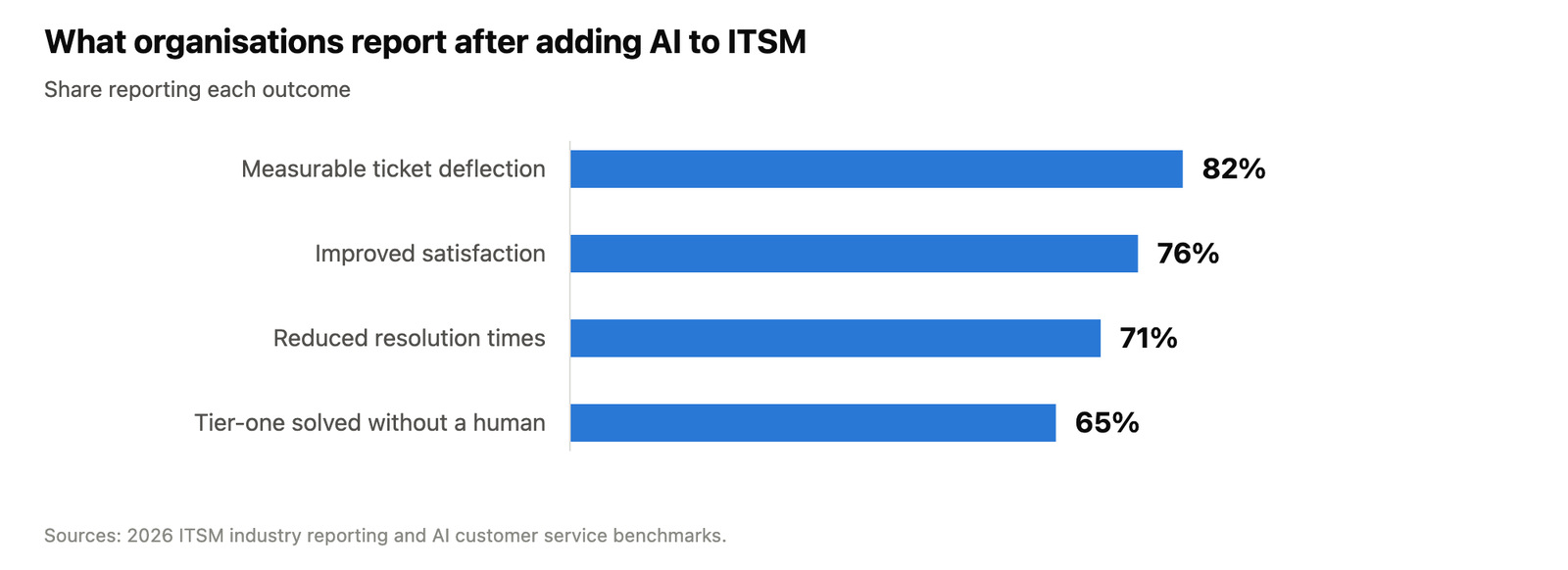
The credible numbers are genuinely good. Around 82% of organisations using AI in ITSM report measurable ticket deflection, 71% report reduced resolution times and 76% report improved satisfaction. Companies using AI for tier-one support resolve roughly 65% of issues without human involvement, and AI-native platforms report first contact resolution between 55% and 70%.
One 2026 help desk benchmark found AI automation letting teams resolve tickets around sixteen times faster than teams without it. That is not a rounding error, it is a different operating model.
The Distinction Nobody Explains
Deflection and resolution are different outcomes, and vendors blur them constantly.
Deflection means the ticket never reached a human. That can mean it was solved, or it can mean the user gave up and asked a colleague instead. Both look identical in the dashboard.
Autonomous resolution means the issue was actually fixed end to end. A triage-only AI saves minutes per ticket. A resolution AI saves whole tickets. Only one of those changes your staffing model.
The Metrics Worth Tracking
| Metric | What it really tells you |
|---|---|
| Autonomous resolution rate | The only number that reduces workload |
| Reopen rate | Whether deflection was real or wishful |
| Escalation quality | Does the human get useful context or start cold |
| Time to first useful action | Better than time to first response |
| Cost per resolution | Including the AI spend, honestly |
Watch reopen rate above all. A high deflection rate paired with a rising reopen rate means you have not automated support, you have automated a delay.
Where AI Genuinely Wins in a Service Desk
- Password and access requests. High volume, low ambiguity, easy to verify.
- Software installs and licence provisioning. Repetitive and rule shaped.
- Status and update requests. Pure lookup, no judgement.
- Triage and routing. Even without resolution, correct routing saves real time.
- Knowledge article drafting. Every resolved ticket becomes documentation, which is the compounding benefit almost nobody counts.
Where It Struggles
Anything requiring physical action, anything where the user description is wrong in an interesting way, and anything political. When a director says the laptop is broken and the real issue is that they hate the new VPN policy, no amount of automation resolves that.
Be careful with the compliance edge too. Faster resolution means little if it comes at the cost of data quality or an audit trail, and service desks touch identity, which is exactly where auditors look.
Conclusion
The deflection numbers are real, but ask any vendor for autonomous resolution rate and reopen rate before you sign. Start with password resets and access requests, measure whether the tickets stay closed, and make every resolved ticket produce a knowledge article. That last habit is what turns a good quarter into a permanently cheaper service desk.
Frequently Asked Questions
Will AI replace tier-one support staff?
It changes the job more than it removes it. Volume drops, but the remaining tickets are harder, so the skill floor rises. Most teams redeploy rather than cut.
How long before we see results?
Password and access flows can show results within weeks. Anything needing integration into your CMDB and asset data takes a quarter, mostly because your data is messier than you think.
What is a realistic autonomous resolution rate?
For tier-one categories, somewhere in the 50% to 65% range is defensible. Claims well above that usually include deflection that never resolved anything.